JoJo’s Bizarre Adventure Watch Order: The Ultimate Word Guide
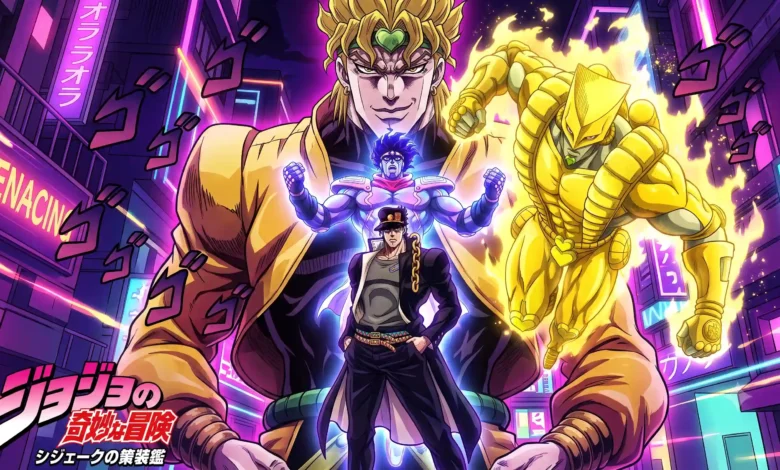
JoJo’s Bizarre Adventure (often abbreviated as JJBA) is not just an anime; it is a sprawling, multi-generational cultural phenomenon that has permanently reshaped the landscape of global pop culture. Written and illustrated by the visionary mangaka Hirohiko Araki, the series began serialization in Weekly Shōnen Jump all the way back in 1987. For decades, it existed as a massively popular franchise in Japan while remaining a relatively niche, cult classic in the West. That all changed in 2012 when David Production took on the monumental task of creating a faithful, highly stylized, and deeply passionate modern anime adaptation.
Since the anime’s explosive debut, the internet has been flooded with JoJo memes, iconic poses, and musical references. However, the sheer size of the franchise can be incredibly intimidating for newcomers. Unlike traditional shonen anime such as Naruto or One Piece, which follow a single protagonist on a linear journey, JoJo’s Bizarre Adventure is divided into distinct “Parts.” Each Part features a completely new main character, a new setting, a new supporting cast, and often an entirely new genre of storytelling.
Furthermore, the franchise contains older, forgotten OVA (Original Video Animation) adaptations from the 1990s, the confusing Thus Spoke Kishibe Rohan spin-offs, and a massive shift in its core power system halfway through the story. It leaves many new fans asking: “Where do I even begin?” and “Do I really have to watch Part 1?”
To help you navigate the bizarre, unpredictable, and fabulous world of the Joestar bloodline, we have created the most comprehensive and detailed episode guide available anywhere on the internet. We will provide the definitive JoJo chronological watch order, explain the “Part Skipper” debate, break down the transition from Hamon to Stands, and give you a master list of how to navigate the series without missing a single canon moment. Before you strike a pose and awaken your Stand, check out our about us page, or explore more anime watch orders on our site.
- Watch on Crunchyroll (Parts 1 through 5 available)
- Watch on Netflix (Exclusive global home for Part 6: Stone Ocean, and Thus Spoke Kishibe Rohan)
- Watch on Hulu (Select early seasons available – US Only)
Understanding the Unique Structure of JoJo
To truly understand the watch order, you must first understand how Hirohiko Araki structured his magnum opus. The entire narrative of JoJo’s Bizarre Adventure follows the tragic, heroic, and destiny-bound lineage of the Joestar Family. Every main protagonist in the series is a direct descendant of the Joestar bloodline, and through various naming conventions, each one can have their name abbreviated to the nickname “JoJo.”
Each “Part” of the story acts as a standalone narrative with its own distinct flavor. For example, Part 1 is a Gothic horror story set in Victorian England; Part 3 is a globetrotting road-trip adventure across Asia and the Middle East; Part 4 is a slice-of-life murder mystery set in a quiet Japanese town; and Part 5 is a gritty mafia thriller set in Italy. Because each Part has a definitive beginning, middle, and end, the pacing remains incredibly tight, and the series constantly reinvents itself before it has a chance to grow stale.
The Evolution of Combat: Hamon vs. Stands
One of the most confusing aspects for new viewers is the sudden, jarring shift in how the characters fight. If you start the series from the beginning, you will be introduced to a power system known as Hamon (or The Ripple). Hamon is a martial arts technique based on ancient Tibetan breathing exercises. By controlling their breath, users can manifest the energy of the sun through their bodies, allowing them to walk on water, heal wounds, and melt the flesh of vampires and undead creatures. Hamon is the primary power system for Part 1 and Part 2.
However, when Part 3 begins, Hamon is almost entirely abandoned in favor of a revolutionary new power system called Stands. A Stand is a visual, physical manifestation of a person’s life energy and fighting spirit. It typically hovers near the user (hence the name “Stand”) and possesses unique, highly specific supernatural abilities. Some Stands punch at the speed of light, while others can manipulate time, rewrite gravity, or turn objects into bombs. The introduction of Stands changed the anime industry forever, inspiring the power systems of future hits like Hunter x Hunter, Bleach, and Jujutsu Kaisen.
The “Part Skipper” Debate: Why You Must Start at the Beginning
Within the anime community, there is a notorious stigma against “Part Skippers.” Because Part 3 (Stardust Crusaders) is arguably the most famous and iconic era of the franchise—introducing Jotaro Kujo and the concept of Stands—many newcomers are tempted to skip the first two parts entirely and jump straight into the action of Part 3.
We strongly advise against skipping Parts. While it is true that Part 1 (Phantom Blood) is often considered the weakest and slowest entry in the series, it is only 9 episodes long. More importantly, Part 1 establishes the blood feud between Jonathan Joestar and the ultimate villain of the franchise, Dio Brando. Understanding the depth of Dio’s hatred for the Joestar bloodline, and the sacrifices made by the early generations, is absolutely critical for the emotional payoff of Part 3 and Part 6. Furthermore, Part 2 (Battle Tendency) is widely regarded by fans as a masterpiece of comedy and action, featuring one of the most charismatic protagonists in anime history, Joseph Joestar. Do not skip the foundation of the series.
The Complete JoJo Chronological Watch Order
Because the modern David Production anime adapts the manga chronologically, the watch order is incredibly straightforward. Simply follow the numbered Parts. The only minor deviation comes from the optional spin-off episodes.
- JoJo’s Bizarre Adventure (Season 1) – Watch Episodes 1–26
- (This season contains both Part 1: Phantom Blood and Part 2: Battle Tendency)
- JoJo’s Bizarre Adventure: Stardust Crusaders (Season 2 / Part 3) – Watch Episodes 1–24
- JoJo’s Bizarre Adventure: Stardust Crusaders – Battle in Egypt (Season 3 / Part 3 Continued) – Watch Episodes 25–48
- JoJo’s Bizarre Adventure: Diamond is Unbreakable (Season 4 / Part 4) – Watch Episodes 1–39
- Thus Spoke Kishibe Rohan (OVA Spin-offs) – Watch Episodes 1–4 (Optional: Best watched after Part 4)
- JoJo’s Bizarre Adventure: Golden Wind (Season 5 / Part 5) – Watch Episodes 1–39
- JoJo’s Bizarre Adventure: Stone Ocean (Season 6 / Part 6) – Watch Episodes 1–38
Franchise Canon vs. Filler Breakdown
One of the absolute greatest strengths of the David Production adaptation is its unwavering loyalty to Hirohiko Araki’s original manga. There are virtually zero filler episodes in the modern JoJo’s Bizarre Adventure anime.
Because the studio was adapting a manga that had already been completed decades prior, they never had to invent non-canon storylines to buy time for the author to write more chapters. While the anime does occasionally trim minor dialogue or slightly extend a fight sequence for cinematic pacing, every single episode is considered strict manga canon. You will not find any beach episodes, pointless recap clip shows, or non-canon filler arcs interrupting the narrative flow.
| Series / Part | Total Episodes | Manga Canon | Filler / Anime-Original | Filler Percentage |
|---|---|---|---|---|
| Season 1 (Parts 1 & 2) | 26 | 26 | 0 | 0% |
| Stardust Crusaders (Part 3) | 48 | 48 | 0 | 0% |
| Diamond is Unbreakable (Part 4) | 39 | 39 | 0 | 0% |
| Golden Wind (Part 5) | 39 | 39 (Ep 39 is Canon/Recap Hybrid) | 0 | 0% |
| Stone Ocean (Part 6) | 38 | 38 | 0 | 0% |
| Total Franchise | 190 Episodes | 100% Canon | 0 | 0% |
Detailed Part-by-Part Episode Guide
Use the expandable accordions below to read a deeply detailed, spoiler-free summary of every major Part of the franchise. This will help you understand the thematic shifts, the generational leaps, and the iconic villains that define each era of the Joestar bloodline.
Part 1: Phantom Blood (Season 1, Episodes 1–9)
- Status: 100% Canon
- Protagonist: Jonathan Joestar
- Setting: 1880s Victorian England
- Summary: The epic saga begins with a tale of wealthy aristocracy, bitter jealousy, and ancient curses. Jonathan Joestar, a pure-hearted and noble young gentleman, lives a life of privilege until his father adopts an impoverished boy named Dio Brando. Dio is fiercely ambitious, sociopathic, and determined to systematically destroy Jonathan’s life to steal the Joestar fortune. The bitter sibling rivalry escalates into supernatural horror when Dio discovers the dark secret of a mysterious Aztec Stone Mask, which transforms him into an immortal, blood-sucking vampire. To defeat his adoptive brother, Jonathan must learn the ancient, sun-based martial art of Hamon under the eccentric master Will A. Zeppeli.
- Verdict: MUST WATCH. It is the shortest Part in the series and acts as the crucial foundation for everything that follows.
Part 2: Battle Tendency (Season 1, Episodes 10–26)
- Status: 100% Canon
- Protagonist: Joseph Joestar
- Setting: 1938 New York, Mexico, Italy, and Switzerland
- Summary: Fifty years after the tragic events of Phantom Blood, the story shifts to Jonathan’s grandson, Joseph Joestar. Unlike his noble and highly disciplined grandfather, Joseph is a brash, hot-headed, street-smart trickster who relies on sleight-of-hand, psychological warfare, and tactical retreats to win his battles. When a Nazi expedition unearths a group of ancient, god-like beings known as the “Pillar Men” (the very creators of the vampire-making Stone Mask), Joseph is forced to team up with an Italian Hamon master named Caesar Zeppeli to prevent the apocalypse.
- Verdict: MUST WATCH. The pacing is spectacular, the comedy is top-tier, and Joseph is frequently cited as one of the best protagonists in anime history.
Part 3: Stardust Crusaders (Season 2 & 3, Episodes 1–48)
- Status: 100% Canon
- Protagonist: Jotaro Kujo
- Setting: 1987 Japan, Asia, and Egypt
- Summary: The franchise undergoes a massive paradigm shift. Dio, having survived at the bottom of the ocean for a century by stealing Jonathan Joestar’s body, awakens. His resurrection triggers a distress signal across the Joestar bloodline, causing them to develop “Stands.” An older Joseph Joestar travels to Japan to recruit his delinquent, stoic teenage grandson, Jotaro Kujo (wielder of the incredibly powerful Stand, Star Platinum). Joined by a colorful cast of international Stand users (Avdol, Kakyoin, Polnareff, and the dog Iggy), the crew has exactly 50 days to travel from Tokyo to Cairo, Egypt, to assassinate DIO and lift a fatal curse placed on Jotaro’s mother.
- Verdict: MUST WATCH. This is the cultural touchstone of the franchise. It establishes the “Monster of the Week” format that defines the rest of the series.
Part 4: Diamond is Unbreakable (Season 4, Episodes 1–39)
- Status: 100% Canon
- Protagonist: Josuke Higashikata
- Setting: 1999 Morioh (Fictional Japanese Town)
- Summary: Taking a sharp turn away from the world-ending stakes and globetrotting adventures of Part 3, Part 4 is a vibrant, slice-of-life murder mystery. Jotaro Kujo arrives in the quirky, pastel-colored town of Morioh to track down Joseph Joestar’s illegitimate son, Josuke Higashikata. They soon discover that a mystical Bow and Arrow is granting dangerous Stand powers to the local residents. The seemingly peaceful town is actually the hunting ground of Yoshikage Kira, a meticulously organized, quiet serial killer who uses his explosive Stand, Killer Queen, to murder women and leave no evidence behind.
- Verdict: MUST WATCH. Praised for its incredible, chilling villain and unique color palette, Part 4 is a fan-favorite that perfectly balances comedy with psychological horror.
Part 5: Golden Wind (Season 5, Episodes 1–39)
- Status: 100% Canon
- Protagonist: Giorno Giovanna
- Setting: 2001 Italy
- Summary: The story shifts to Naples, Italy, following the incredibly complex lineage of Giorno Giovanna—the biological son of DIO, conceived using Jonathan Joestar’s stolen body. Despite his villainous heritage, Giorno possesses a strong sense of justice and a dream to become a “Gang-Star.” He infiltrates Passione, a ruthless and powerful Italian mafia syndicate composed entirely of Stand users. Teaming up with the squad leader Bruno Bucciarati, Giorno and his new crew plot to overthrow the mysterious, paranoid boss of Passione (Diavolo) to stop the organization from selling drugs to children.
- Verdict: MUST WATCH. Featuring the most fashionable character designs, the most brutal and creative Stand battles in the series, and an iconic soundtrack, Part 5 is an absolute masterpiece of the medium.
Part 6: Stone Ocean (Season 6, Episodes 1–38)
- Status: 100% Canon
- Protagonist: Jolyne Cujoh
- Setting: 2011 Florida, United States
- Summary: The grand finale to the original Joestar timeline. Jotaro’s estranged daughter, Jolyne Cujoh, is framed for a murder she didn’t commit and sentenced to 15 years in the maximum-security Green Dolphin Street Prison. It is soon revealed that her imprisonment was orchestrated by Enrico Pucci, the prison’s sinister chaplain and a devout, fanatical follower of the deceased DIO. When Pucci uses his Stand (Whitesnake) to steal Jotaro’s memories and Stand disc, leaving him in a coma, Jolyne must awaken her own Stand (Stone Free) to survive the brutal prison environment, retrieve her father’s soul, and stop Pucci from literally resetting the universe to achieve “Heaven.”
- Verdict: MUST WATCH. The emotional, mind-bending conclusion to a storyline that was decades in the making.
The Classic 1993 and 2000 OVAs: A Relic of the Past
Before David Production modernized the series in 2012, an animation studio called Studio APPP produced a series of Original Video Animations (OVAs) based exclusively on the second half of Part 3 (Stardust Crusaders) in 1993. Years later, in 2000, they produced a prequel OVA series to cover the first half of Part 3.
While these OVAs feature gritty, old-school 90s animation and some incredibly atmospheric fight scenes, they are highly condensed, heavily altered, and ultimately skippable. They change character designs, remove numerous important fights entirely, and fail to capture the colorful, vibrant aesthetic that defines Araki’s manga. If you are a modern viewer, stick entirely to the David Production television series. The OVAs are simply an interesting historical artifact for hardcore fans to revisit later.
The Spin-Offs: Thus Spoke Kishibe Rohan
During the airing of the main series, a spin-off titled Thus Spoke Kishibe Rohan was released as a series of 4 standalone OVA episodes (which were later licensed for global distribution by Netflix).
This spin-off focuses on Rohan Kishibe, the eccentric, brilliant, and deeply arrogant manga artist introduced in Part 4 (Diamond is Unbreakable). Traveling the world to gather inspiration and “realism” for his manga, Rohan uses his Stand, Heaven’s Door (which can turn people into books, allowing him to read their memories and write commands into their minds), to investigate bizarre, supernatural horror phenomena that are completely unrelated to the main plot.
Are they canon? Yes, they are written by Hirohiko Araki and fit into the timeline after the events of Part 4. However, they are episodic horror mysteries that do not advance the main Joestar plot. They are highly recommended for fans of psychological horror and those who loved the Morioh cast.
The Musical Localization Problem: Subtitles vs. Dubs
One of the most hilarious, confusing, and frustrating aspects of watching JoJo’s Bizarre Adventure in the West is the localization of names. Hirohiko Araki is an absolutely massive fan of Western rock, pop, and R&B music. Because of this, almost every single character, villain, and Stand in the series is named directly after a famous band, song, or album.
For example, you have characters named Robert E. O. Speedwagon, AC/DC, and Red Hot Chili Pepper, alongside Stands named Killer Queen, King Crimson, Aerosmith, and Sticky Fingers.
Due to extremely strict copyright and trademark laws in the United States and Europe, the English localizers (for both the official English Dubs and the Crunchyroll/Netflix Subtitles) had to alter these names to avoid massive lawsuits. This leads to incredibly jarring moments where you will clearly hear the Japanese voice actor scream the English words “STICKY FINGERS!”, but the subtitles will inexplicably read “Zipper Man!”
Other infamous localized name changes include Killer Queen becoming “Deadly Queen,” Crazy Diamond becoming “Shining Diamond,” Aerosmith becoming “Lil’ Bomber,” and the villainous King Crimson becoming “Emperor Crimson.” While this can be incredibly distracting for new viewers, you eventually get used to the “legally distinct” copyright-dodging names.
What Comes Next? The Future of JoJo and Steel Ball Run
With the conclusion of Part 6 (Stone Ocean), the original Joestar timeline—the blood feud stretching from Jonathan to Jolyne—is officially over. The ending of Part 6 essentially acts as a massive reset button for the franchise.
Hirohiko Araki did not stop writing, however. He shifted the manga to a monthly seinen publication and completely rebooted the universe. Part 7: Steel Ball Run takes place in an entirely new, alternate universe in the late 1800s, focusing on a massive cross-country horse race across the United States. Following an alternate-universe version of Jonathan (Johnny Joestar) and a new Zeppeli (Gyro), it introduces the concept of the “Spin” alongside a completely revitalized approach to Stands.
Steel Ball Run is widely considered by manga readers to be Araki’s absolute magnum opus, boasting the highest ratings of the entire franchise. Following Part 7 is Part 8: JoJolion, and the currently serializing Part 9: The JoJoLands. While David Production has not yet officially announced the anime adaptation of Steel Ball Run, it is considered one of the most highly anticipated, inevitable anime announcements of the decade.
Frequently Asked Questions (FAQ)
Why does the art style change so drastically between Parts?
Because the original manga has been running continuously since 1987, Hirohiko Araki’s art style has evolved massively over the span of 30+ years. He started in the 80s drawing massive, hyper-muscular, Fist of the North Star-style characters for Parts 1 through 3. As the series progressed into the late 90s and 2000s, his art shifted toward high-fashion, androgynous, slender, and highly stylized anatomical proportions. David Production honors this evolution by intentionally changing the character designer and color palettes for every single season of the anime to match Araki’s shifting manga aesthetic.
Do the animals in JoJo survive?
This is a notoriously dark running joke in the community. Hirohiko Araki frequently uses the brutal, unprovoked killing of a dog to immediately establish how evil a new villain is. If you are sensitive to animal cruelty, be warned that the franchise has a very high mortality rate for canine characters, particularly in Parts 1 and 3.
What does “JoJo” actually stand for?
The nickname “JoJo” is derived by combining the first syllables of a protagonist’s first and last name. For example: Jonathan Joestar. Joseph Joestar. Jotaro Kujo. The trend slightly breaks with Giorno Giovanna (GioGio, pronounced the same in Italian) and Josuke Higashikata (the kanji for ‘suke’ can alternatively be read as ‘Jo’).
Is the Joestar Bloodline cursed?
Thematically, yes. Throughout the series, it is repeatedly stated that those born into the Joestar bloodline (distinguishable by a star-shaped birthmark on the back of their left shoulder) are bound by “gravity” and “fate” to live short, tragic, and incredibly violent lives. They are destined to attract other Stand users and are perpetually bound to the legacy of their conflict with Dio.